Monday, 14 November 2011

The medieval wedding ceremony


From an amasing wedding posted in
the Londond Evening Standard
It's kind of strange that I have been writing on this blog for over 6 months about medieval weddings but I haven't mentioned the actual ceremony yet, so here it comes.
The Middle Ages was a long period and therefore the cermonial part of the wedding probably changed some over time. The church had great power but it took some time for the Christian ways to beat the older tradtions and form into that solidified ritual we know today.

From what I can gather the medieval ceremony was a very undefined thing. They only thing that was required for a marriage to be legally binding was consent between man and wife followed sooner or later by sex. A secret runaway wedding in the forest without a priest was as binding as the formal one where all guests gathered as witnesses.
From StyleMePretty
The church did prefere the ceremonies involving a priest as it was easier if the couple wanted an annulment when there had been no priest or family there to witness that it actually took place. And divorce was a sin at the time.
In the late Medieval Times the common way to have a ceremony was to walk with all the guests up to the church. Outside the church the couple would declare their consent and the priest would bless their union. Then everyone would go inside and attend mass.

From Facta et dicta memorabilia - second quarter of the 15th century
In Denmark a wedding is called "Bryllup" which derives from the old word Brudhlaup which means: Bridal run. It comes from a tradition where the entire wedding party would walk through the city in a procession. I am not certain if this was a demonstration of the magnitude of the wedding or simply a way to celebrate.

If you want a ceremony that's medieval you can almost make up want you want as there was no specific rules as to how it should be. If you prefere an outdoor wedding it will be as accurate as a wedding in a church. We have some litterary sources of the cermoniel words dating back to the renaissance that probably derives from medieval ceremonies.

If you want to read a little more my source was this article by Sharon L. Krossa

Thursday, 10 November 2011

Dress of the month - November

This golden empire waist gown is designed and made by Corinne Roes of Atelier Mette Maelwael, from the Netherlands.

It's not for sale, but made as a replica to a museum and meant as an inspiration for you all, so you can see the difference between this and the early slim and simple dresses.
The shape is characteristic for the 15th century with its big skirt, high waist and the v-shaped collar*. Also the conic hat with a veil is typical for the period. I believe the type of dress was called a Houpelande.

It was made by using at the picture below as an inspiration. Frankly I think it's very romantic and brings to mind princesses locked away in tall towers without any doors.
The Romance of Tristan; France, 1468


Wednesday, 2 November 2011

Wedding tree guestbook

I have seen this idea on most blogs by now, but I want to publish it here as well because I actually think it could fit a medieval wedding really well.
The concept is that you draw a tree on a big piece of paper, then you find different colored ink pads that the guests can press their fingers in and then leave a gren/yellow/red finger print on the tree as a leaf. Underneath they can write their name if they want to.
The reason I love this idea, is that many medieval people could not read or write and what better way to leave a mark on the wedding that this?

Tuesday, 1 November 2011

Arn the knight templar: Cecilia's hair

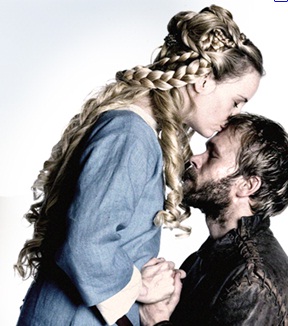
I was watching the first Arn - the templar knight, the other evening. I do like that movie, although the book is far better. Anyway I can see that you often come to this blog looking for medieval wedding hair. Obviously a movie cannot provide us historically accurate hair styles, but they can inspire us and as a lot of movies takes pride in historical clothing, they also try to copy the hair dos of the period. Cecilia, the heroine, has a couple of hair styles that I could really see at a wedding.

'
The braided bun above is beautiful. Medieval paintings are full of smal buns of braided hair, although I have never seen one placed in the back of the head. It requires a great amount of hair to make it that big, but I am sure hairdressers have their tricks if you want something similar. It reminds me a bit of this Jessica Alba picture:

This very artistic braided and curled hair lokks very much like a fairy tale princess. This elaborate style is more common in the renaissance or in Italy 15th century while nortern Europe still are in the middle ages. The Arn movie takes place in the 12th century if I remember correctly. From the paintings of that century this next hair style is the one that fits the best:
This simple and flattering hair do is the one that appeals the most to me. You can easily wear a wreath or a crown with it. The long loose wavy style can be seen in manuscripts like the Codex Manesse:
Hope you found these three examples helpful :-)

Monday, 31 October 2011

A shop: Armstreet

This shop was one of the first I found once I started looking and I frequently swing by their website to check out their new stuff. They don't sell exact medieval replicas but their clothing and armor are beautiful! They sell to both men and women and are actually reasonably priced considering the nice stuff they offer.
There's also a couple of extra things besides clothing on their website such as jewelry, delicious leather bags, belts and cloaks. You can get a Galadriel looking crown with golden leaves if you like. In medieval times the bride would often wear a magnificent bridal crown up until the ceremony. A sign of her virtue.
You can easily find an amasing set of clothes for both bride and groom of perhaps the maid of honor.
What impressed me the most is their incredible sets of armor. You can really become a knight i shining armor, but the price also reflects the amount of work put into these war suits.
Most of their clothing comes in all colors and is sown after your meassurements. So check out their website: http://armstreet.com/

Wednesday, 26 October 2011

Inspirational paintings of dresses

Many of the seamstresses who makes history clothing gather their inspiration from periode paintings. I would just like to show you a couple of paintings of potentially amasing wedding gowns:
Banquet of St. Elizabeth of Wartburg, 1480-1500, Slovakia
The woman in the front looks amazing in her gold embroidered green gown with a hint of rosy red under the dress and the night-sky velvet cloak. I am not sure I would wear her veil, but the dress is beautiful.

This gold dress apperently was a fashional wedding look around 1500. In a danish medieval wedding budget from 1501-04(?) a large amount of golden fabric was bought for the wedding dress. And while I am at it, check out his shoes!

Hours of Charles d'Angouleme, late 15th century
The woman in the red dress is also looking stunningly. I love the pattern and the combination of peach-red and baby blue. The train of the dress is also very weddingish.

The lady and unicorn - late 15 century.
I really like the color of her dress. It looks amasing with the gold belt and -pattern. It's a pretty simple dress but still so feminine and graceful.

'Marriage of King Philip III of France to Mary of Brabant in 1274.' From Chroniques de France ou de St. Denis. Published late 1300.
Last but not least, this royal gown, with a light cherry pink underdress and the french blue with golden fleur de lis on the outer dress.
I would really like to see all of these dresses recreated! Maybe I'll try making one myself one day, but I am not that skilled in the art of sewing so I think I might leave it to the professional replica makers. :-)

Wednesday, 19 October 2011

Dress of the month October

As the winds turn colder I thought it would be appropriate to have a dress with long sleeves. I love this dress by DaisyViktoria. It's 14th century and the belt makes a nice accessory to this almost heraldic looking gown. I like the fact that men isn't the only ones who can wear garments in the family colors.

It gives the impression of a proud woman with strong roots. And just look at her fine accessories, the crown, the buttons and her pretty belt.